Sealand: The Country the Size of a Tennis Court That Survived a Coup, a Mercenary Invasion, and the British Navy
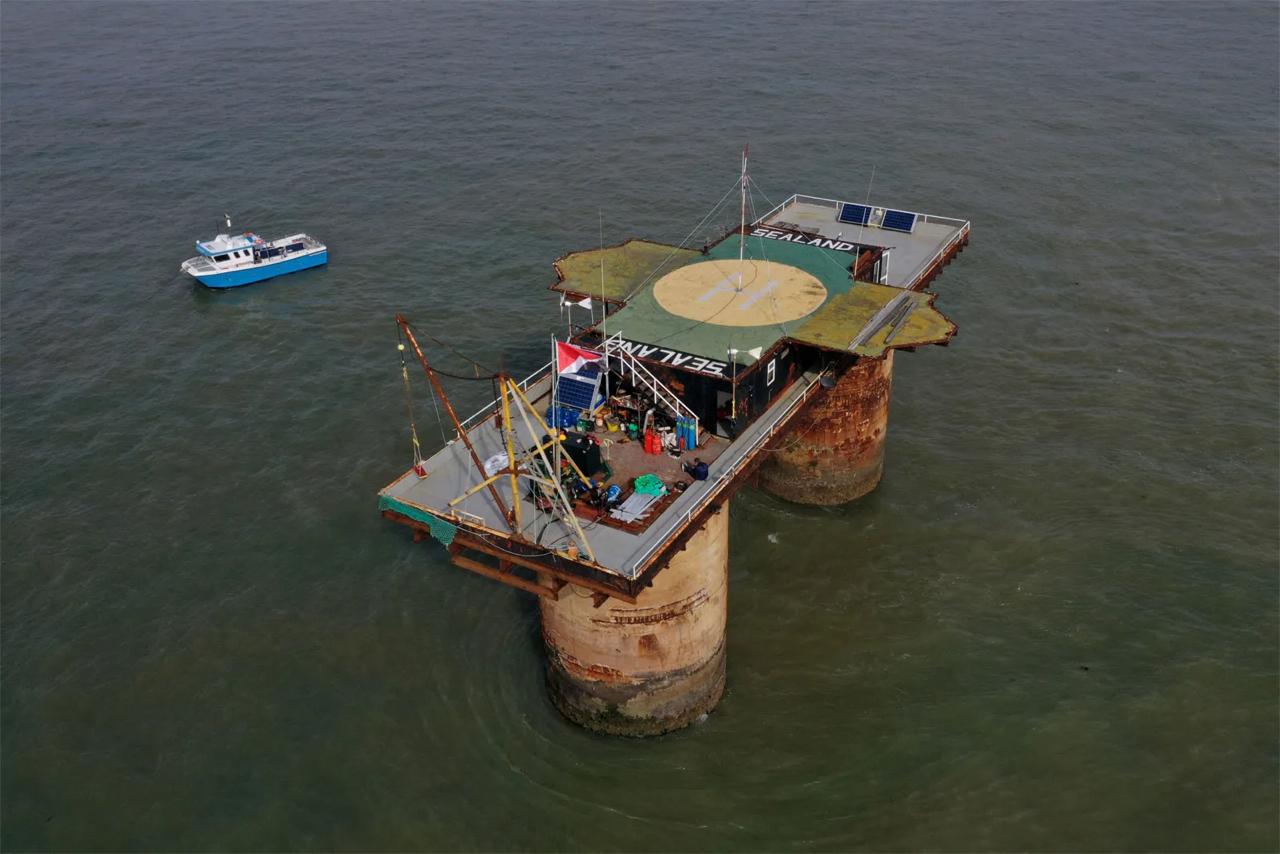
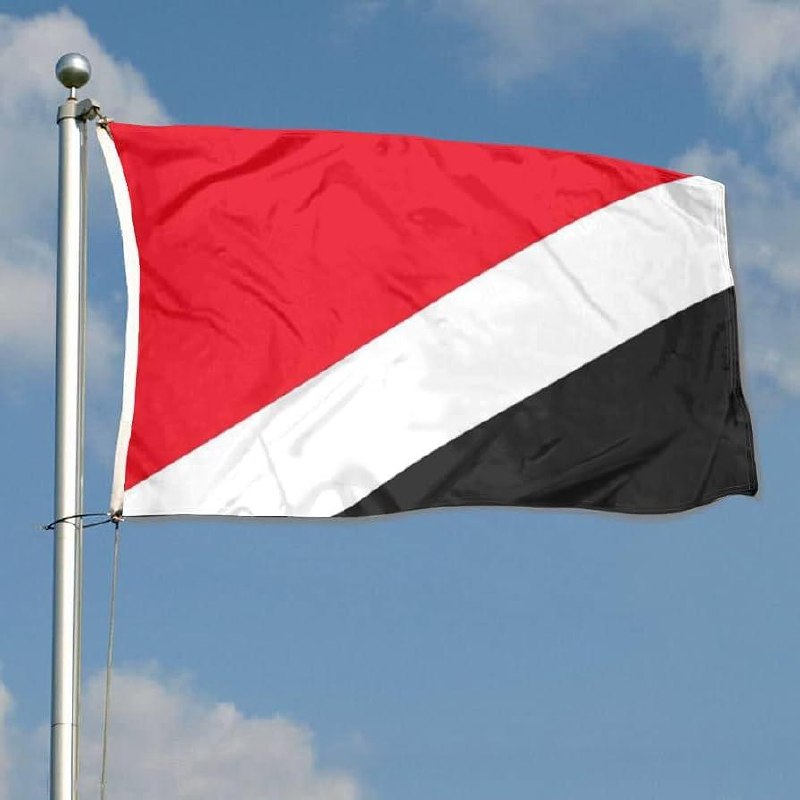
Seven miles off the coast of England, in the grey waters of the North Sea, there is a country. It has a flag, a constitution, a national anthem, its own currency, and a motto: E Mare Libertas — From the Sea, Freedom. Its entire territory is a rusting steel platform the size of a tennis court, resting on two hollow concrete pillars above the waves.
It has never been recognized by any other nation. It has been invaded by mercenaries. Its prince counter-attacked by helicopter, armed with sawn-off shotguns, piloted by a James Bond stunt pilot.
It Started With Pirate Radio
In the 1960s, Britain had a problem. The BBC held a monopoly on radio broadcasting, and millions of people wanted rock and roll. Entrepreneurs solved this the only way available to them: by anchoring ships and platforms in international waters just outside British jurisdiction and broadcasting from there. These were the pirate radio stations — Radio Caroline, Radio London, and dozens of others — and the British government hated them.
Roy Bates was one of the pirates. A former British Army major turned broadcaster, he ran his own station and needed a new platform after the government shut down his previous operation. He found one — Roughs Tower, a World War II naval fortress that had been built in international waters to defend England from German air and sea attacks, then abandoned after the war. In late 1966, he sailed out and took it.
He didn't put his transmitter up, though. Standing on that platform, answerable to no government, he saw something bigger than a radio station. On 2 September 1967, Roy Bates declared Roughs Tower an independent sovereign state: the Principality of Sealand. He named himself Prince Roy. His wife became Princess Joan.
The Court Case That Built a Nation
A year later, a British vessel approached the platform to service a nearby navigational buoy. Roy's teenage son Michael — guarding the fortress alone — fired warning shots to drive them off.
Michael was hauled before a British court on firearms charges. It looked like the end of the experiment. Instead, it became Sealand's founding legal document.
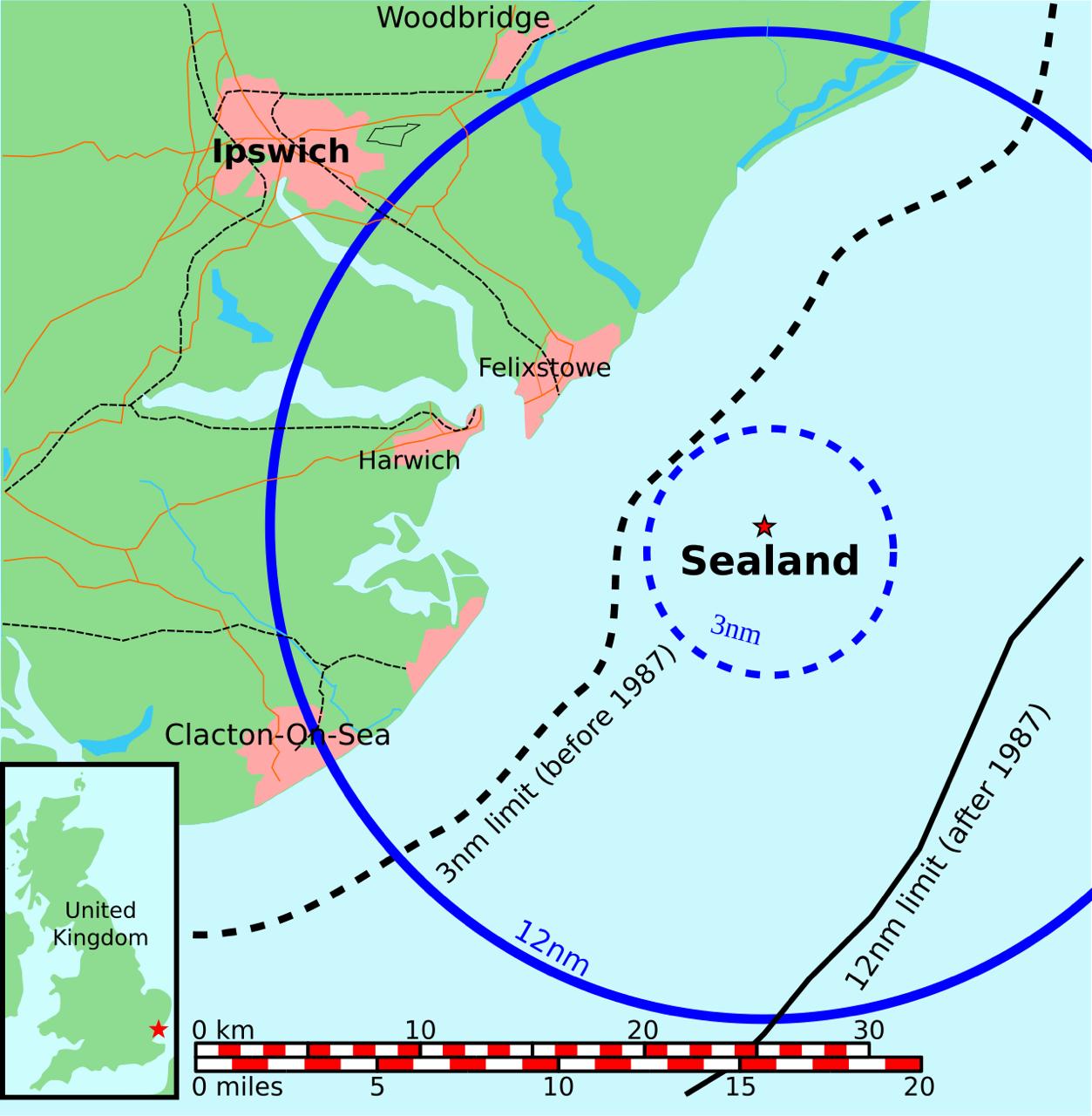
The court ruled that Roughs Tower lay outside British territorial waters — beyond the three-nautical-mile limit that applied at the time — and therefore outside British jurisdiction. The case was dropped. Sealand interpreted this as de facto confirmation that it was beyond British law entirely. The principle still holds today in Sealand's legal arguments for its own sovereignty.
By 1975, Sealand had a written constitution, a flag, a national anthem, passports, stamps, and its own currency. For something that doesn't officially exist, it was remarkably well-organized.
The Coup
In the 1970s, a German businessman named Alexander Achenbach arrived with grand plans — a casino, a hotel, a post office, a vision of Sealand as a North Sea Monaco. Roy Bates made him Foreign Minister.
The partnership soured. In August 1978, while Prince Roy and Princess Joan were in Austria on a separate business trip, Achenbach made his move. A helicopter appeared over Sealand carrying Achenbach's men — Dutch and German mercenaries, arriving under the pretense of a business meeting. Michael Bates, alone on the platform, was overpowered and locked in a steel room. After several days as a hostage on his own nation's soil, he was flown to the Netherlands and abandoned there with no money and no passport.
Achenbach's men had Sealand.
They did not have it for long.
The Counter-Invasion
Michael made his way back to England and told his father. Roy assembled a small team, armed them, chartered a helicopter, and hired Captain John Crewdson — a stunt pilot who had flown for the James Bond films — to take them in. They flew out at dawn, abseiled down onto the platform, and stormed it. The mercenaries surrendered unconditionally.
A Trial for Treason
Roy Bates did something no head of a self-declared micronation had done before: he charged the captured mercenaries under Sealand law with treason against the state — a crime that, according to Sealand's constitution, carried the death penalty. It was never intended to be carried out, but the paperwork was entirely real.
One German national was held as a prisoner of war. He was tried under Sealandic law, convicted of treason against the Principality, and imprisoned in the bottom of the north tower. Germany lobbied Britain for his release; Britain declined to get involved, stating that the platform was beyond their jurisdiction. Facing no other options, Germany sent a diplomat from its London embassy directly to Sealand by helicopter to negotiate. Sealand considers that diplomatic visit — a government officially sending a representative to deal with them — as the closest thing it has to international recognition.
Achenbach never let it go. Back on the mainland, he declared a government-in-exile — a self-styled rightful government of Sealand — which still exists today as a rival claim on the internet, decades later.
The Internet Chapter
In 2000, a group of cypherpunks and internet libertarians looked at Sealand and saw something new: a sovereign territory outside the reach of any government's data laws, sitting in the North Sea with a direct fiber connection. They launched HavenCo — a data haven that would host content illegal in other countries, beyond the reach of any court.
The idea made the cover of Wired magazine. It drew massive press. It had at most a dozen customers, mostly online gambling operations and one company making unauthorized software for IBM mainframes. A fire on the platform, the defection of a co-founder, and the fundamental problem that Sealand's "sovereignty" was only as strong as Britain's willingness to ignore it — all of these combined to end HavenCo within a few years.
The platform sat mostly empty after that.
What Sealand Is Now
Prince Roy died in 2012. His son Michael — the same Michael who was held hostage in 1978 and who fired warning shots at the Royal Navy as a teenager — is now Prince Michael of Sealand. The platform is typically staffed by one or two people, sometimes none.
Sealand sells noble titles online. You can become a Lord, Lady, Baron, or Baroness of Sealand for a fee. It sells merchandise. It has sports teams that play exhibition matches — the Sealand Seahawks American football team, a cricket squad, a basketball team. It hosts an annual charity swim around the platform.
In 1987, Britain extended its territorial waters to 12 nautical miles, which technically put Sealand inside British waters for the first time. Sealand responded by declaring its own 12-nautical-mile zone simultaneously. The argument has never been resolved. Britain has, for nearly sixty years, found it easier to leave the Bateses alone.
Is It Really a Country?
No United Nations member state recognizes Sealand. But the question of what actually makes a country a country is less settled than most people assume. Under the 1933 Montevideo Convention, a state needs a permanent population, a defined territory, a government, and the capacity to enter into relations with other states. Sealand has spent decades arguing — through a 1968 court case, a captured diplomat, a constitution, a currency, and a stack of passports — that it satisfies all four. Law schools use it as a teaching case precisely because it refuses to give a simple answer.
Fun Facts
- Sealand's constitution has never actually carried out its death penalty for treason — it's on the books, but nobody has been executed
- Its currency, the Sealand dollar, is pegged to the US dollar and mostly sold to collectors rather than spent
- Fraudulent Sealand passports turned up in several international criminal cases in the 1990s and 2000s, prompting the principality to invalidate every passport issued before 1997
- The platform's actual population is usually just a handful of caretakers — most of its tens of thousands of "citizens" are titled Lords and Ladies who have never set foot there
- Sealand isn't open to casual tourism; the platform can't safely host visitors, though boat tours sometimes pass close by
Location: Former HM Fort Roughs, North Sea, ~12 km off Felixstowe, Suffolk, England
Getting there: Sealand is not open to casual visitors. The platform sits 12 km off the Suffolk coast; occasional authorized visits are arranged through the Sealand government website at sealand.gov.