The Swedish Solar System: a 950-kilometer road trip
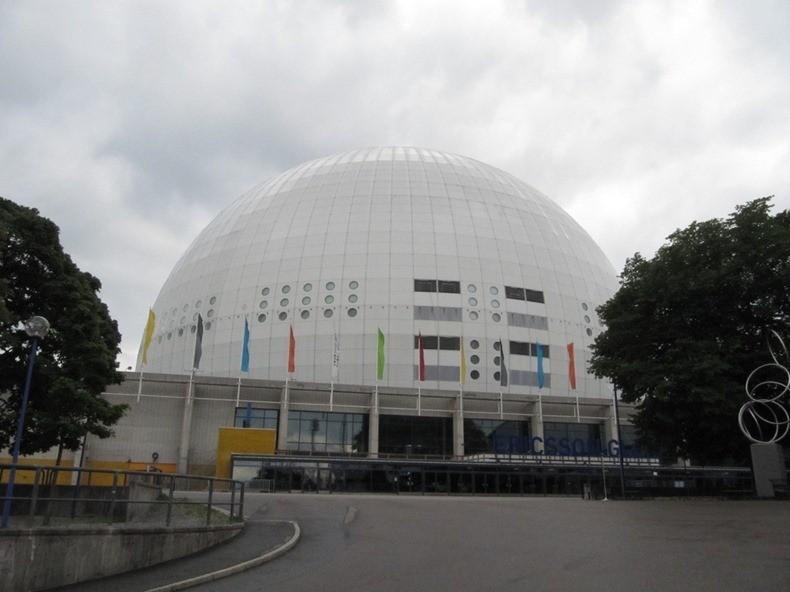
Imagine driving down a highway somewhere in Sweden and suddenly realizing you just passed Saturn. Neptune is still about 160 kilometers north. This isn't science fiction — it's the Sweden Solar System, the largest scale model of the Solar System in the world.
How it works
In the late 1990s, two Swedish scientists — Professor Nils Brenning of the Royal Institute of Technology (KTH) and Professor Gösta Gahm of Stockholm University — came up with something grand. They decided to place a scale model of the Solar System directly on the map of Sweden, at a scale of 1:20,000,000.
From there, the journey heads north. Here is each object in the model: the city it stands in, the exact structure, and how to get there.
☀ The Sun — Avicii Arena, Stockholm
The Sun is Stockholm's Avicii Arena (formerly Globen), a huge white sphere 110 meters in diameter. In real life, it's one of the largest spherical buildings in the world. In the model, it's our star — the point every other distance on this page is measured from. Getting there: take the T-bana (metro) to Globen station, right next to the arena, at Globentorget 2.
☿ Mercury — Stockholm
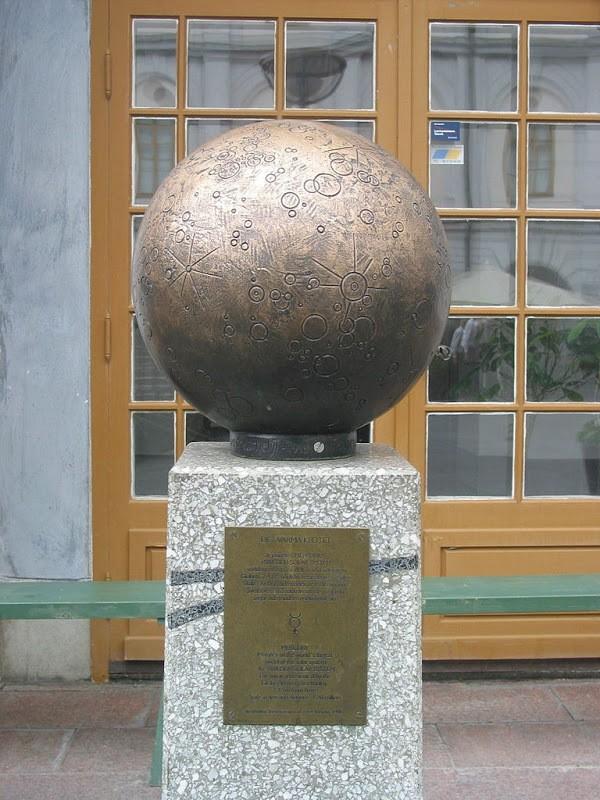
2.99 km from the Sun. A 25 cm metal sphere outside the Stockholm City Museum (Stockholms stadsmuseum) on Slussen, in the heart of the city. Getting there: take the T-bana (metro) to Slussen station — it's a two-minute walk from the exit.
♀ Venus — Stockholm
6.76 km from the Sun. A 62 cm sphere at Vetenskapens hus (the House of Science), on the KTH Royal Institute of Technology campus. The original sphere, installed in 2004, was destroyed in an accident in 2011 and later replaced. Getting there: metro or bus to Tekniska högskolan station, on the KTH campus northeast of central Stockholm.
🌍 Earth & Moon — Stockholm
8.58 km from the Sun. A 65 cm Earth and an 18 cm Moon outside the Swedish Museum of Natural History (Naturhistoriska riksmuseet) in the Frescati district. Getting there: metro to Universitetet station, right next to the museum.
♂ Mars — Danderyd
11.93 km from the Sun. A 35 cm copper model at Mörby Centrum shopping centre in Danderyd, just north of Stockholm. Getting there: the Roslagsbanan commuter train or the metro's red line both stop at Mörby Centrum.
♃ Jupiter — Sigtuna Municipality
40.6 km from the Sun. A glowing ring, 7.3 m in diameter, above the lobby of the Clarion Hotel at Stockholm Arlanda Airport. Getting there: the Arlanda Express train from Stockholm Central, or by car on the E4.
♄ Saturn — Uppsala
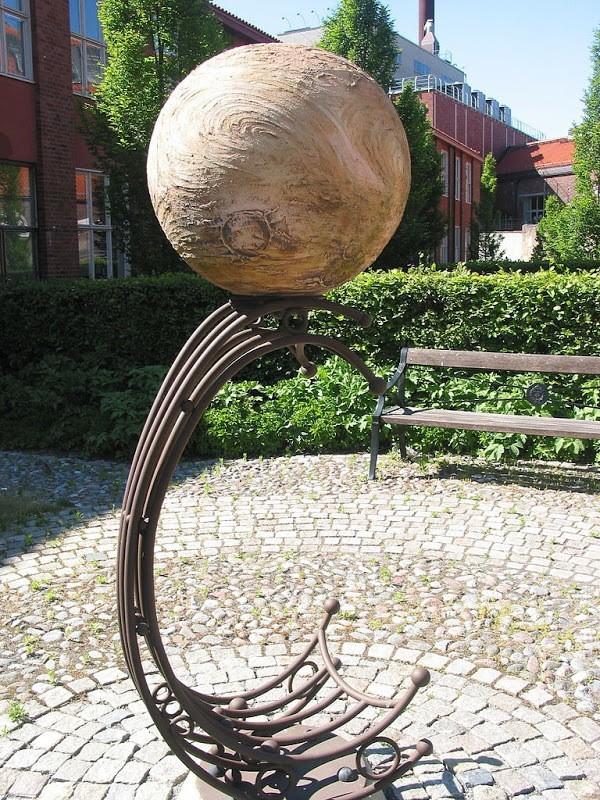
67.9 km from the Sun. A 6.1 m pergola-like structure with 13 m rings at Polacksbacken, a university area in Uppsala. Getting there: direct trains run from Stockholm Central to Uppsala in under an hour; Polacksbacken is a short bus ride or walk from Uppsala station.
⛢ Uranus — Lövstabruk
124.8 km from the Sun. A 2.6 m structure of blue steel bars behind Stora magasinet, in the historic ironworks village of Lövstabruk. Getting there: this one is rural — a car is the practical option, roughly 1.5 hours north of Stockholm.
♆ Neptune — Söderhamn
230.9 km from the Sun. A 2.5 m acrylic sculpture that glows blue at night, by the river Söderhamnsån in Söderhamn, on the Norrland coast. Getting there: by car on the E4, or by train to Söderhamn station.
♇ Pluto & Charon — Delsbo
About 300 km from the Sun. As a dwarf planet beyond Neptune in the model, Pluto and its moon Charon stand near the southern of the Dellen lakes in Delsbo — a short detour off the direct Stockholm–Kiruna route. Getting there: this one is rural — a car is the practical option, off route 84 near Delsbo in Hälsingland.
The road trip: Stockholm to Kiruna
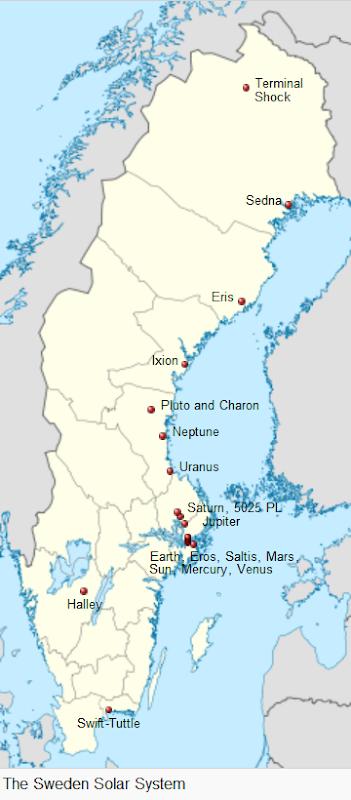
The full model stretches about 950 km, from the Sun in Stockholm to the Termination Shock — the edge of the heliosphere — marked at the Institute of Space Physics in Kiruna, above the Arctic Circle. Driving north, mostly along the E4, you cross the inner planets within the first 40 km inside Stockholm itself, reach Saturn at Uppsala within the hour, and then the distances stretch out: Uranus near Lövstabruk, Neptune on the coast at Söderhamn, Pluto and Charon on a short detour near Delsbo, and finally the long final stretch up through Norrland to Kiruna.
View larger map on OpenStreetMap →Why it's great for a road trip
Driving north from Stockholm along the E4 highway, you literally cross the Solar System. The distances between the planets aren't decoration — they're real scale. Between Earth and Mars is just a few minutes' drive. To Jupiter, it's already half an hour. Only then do you really start to feel the emptiness of space.
Most of the objects are free to visit. They stand by the roads, in parks, near the airport, on city squares. No tickets, no tour guides.
Fun facts
- The model includes more than 60 objects at 26 locations — planets, moons, asteroids, comets, and dwarf planets
- The original Venus sphere, installed in 2004 at the KTH campus, was destroyed when it fell in 2011; a replacement now stands at Vetenskapens hus
- Saturn's pergola structure and rings at Polacksbacken in Uppsala were inaugurated in October 2026, making it one of the newest additions to the model
- Jupiter at Arlanda Airport is a glowing ring above a hotel lobby rather than a solid sphere, because of how small the Sun-to-Jupiter scale makes it
- The whole system was created by Professor Nils Brenning (KTH) and Professor Gösta Gahm (Stockholm University), starting with the Sun in 1989
Address: Globentorget 2, Stockholm
Want places like this narrated automatically? See how the AI audio guide works, try the walking audio guide for exploring cities on foot, or read more on our blog.